BOOK EXCERPT · Part I · Population
Population: more people, a different trajectory
Download this excerpt as PDF ↓
A billion people is almost impossible to picture. A crowded street or a city expanding beyond the roads built to serve it is relatively easy to imagine. The additional homes, schools, water supplies and opportunities needed by another billion human beings are much harder to imagine. That difficulty helped make population one of the strongest opening examples in the original book. What appeared manageable locally became extraordinary when multiplied across the planet.
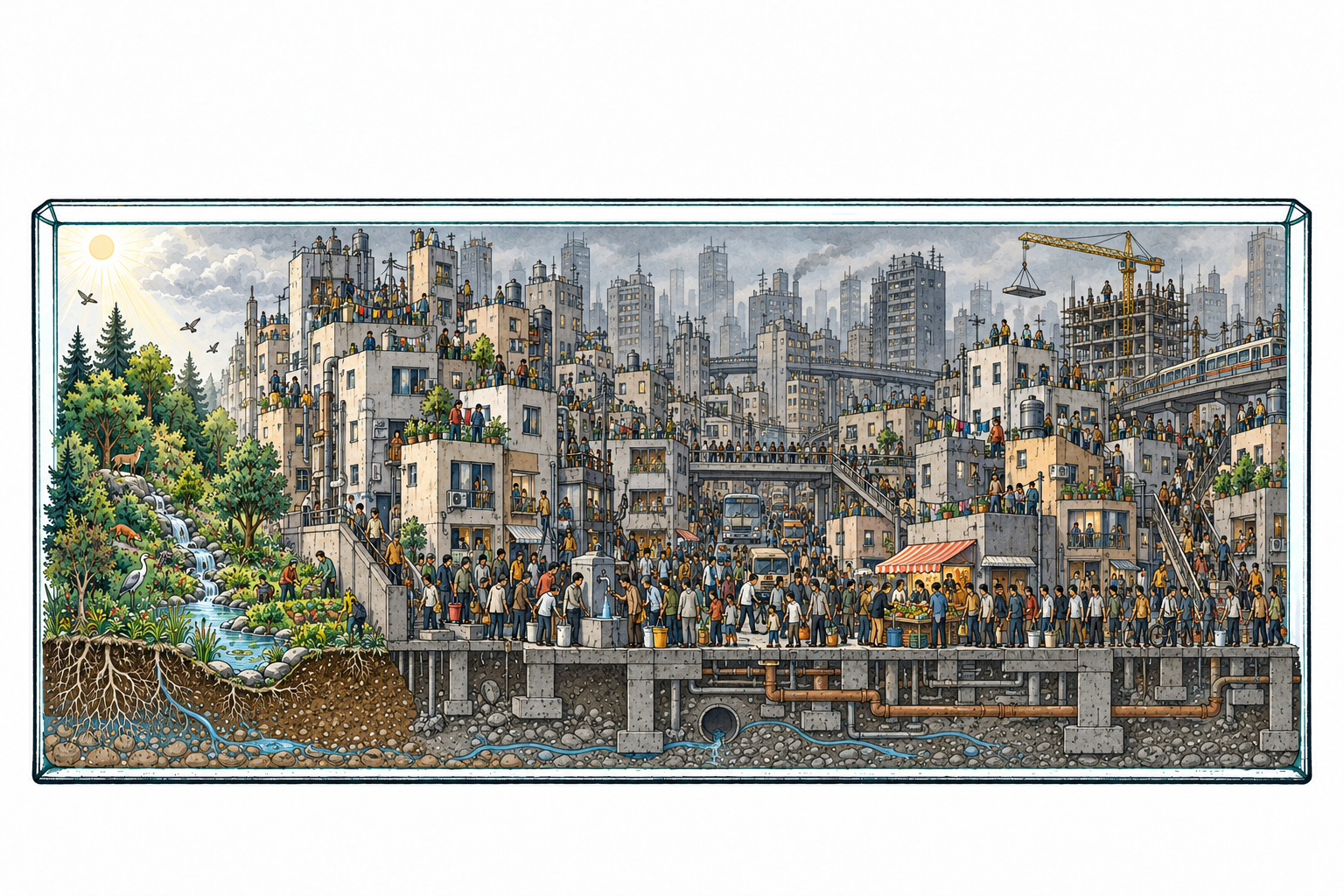
More guests, the same planet. What capacity?
A conceptual illustration of population scale and the limits of the systems that support us. AI-generated image; not a literal estimate of human numbers or carrying capacity.
One prediction from the first edition arrived almost on cue. The first edition placed the eight-billion milestone in 2022; the United Nations later chose 15 November 2022 as the symbolic date when humanity reached it. There is something striking about seeing a number once placed in the future become part of the past. Yet the next pages of the demographic story are less straightforward than an ever-steeper curve would suggest. [I.1, I.3]
The curve bends before the total falls
Between 2016 and 2025, the World Bank series takes us from about 7.53 billion people to 8.22 billion: roughly 687 million additional lives, an increase of 9.1%. But beside that rising total, another line slopes down. Annual population growth falls from about 1.16% to 0.91%. The surprise is that both belong to the same world. Humanity is still getting larger, while the pace of its percentage growth is slowing. [I.2]
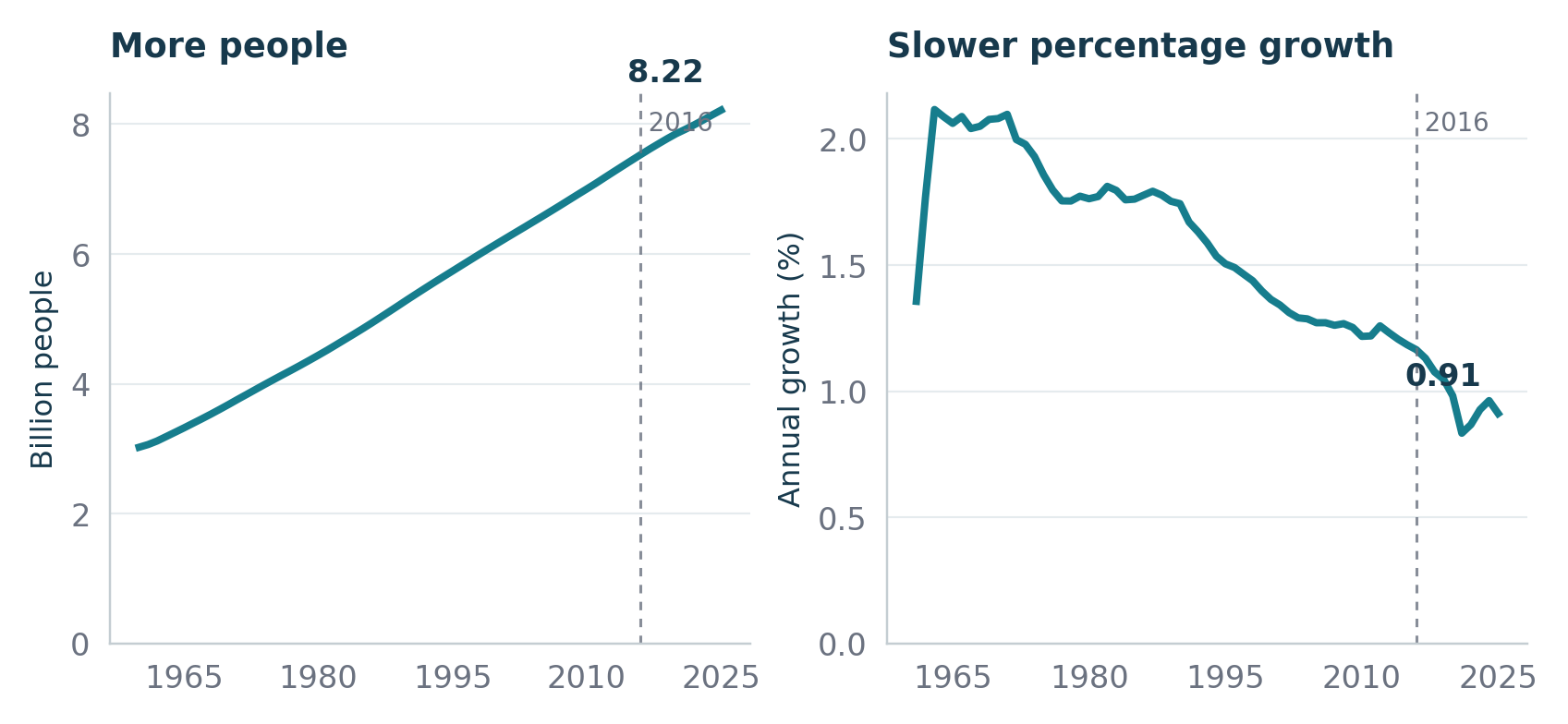
Figure I.2. A growing population with a slowing growth rate. World population, 1960–2025, and annual percentage growth, 1961–2025. These revised World Bank series estimate 8.22 billion people in 2025 and 0.91% annual growth. The dashed line marks the original book’s publication year. [I.2]
The long view
Step back from the last decade and the curve becomes startling again. For much of the past two millennia, humanity numbered only a few hundred million. The historical estimates place the world near one billion around 1800 and at about 2.5 billion by 1950. The recent figures take us beyond eight billion. What feels gradual within a single lifetime becomes extraordinary when seen across generations. [I.2, I.19]
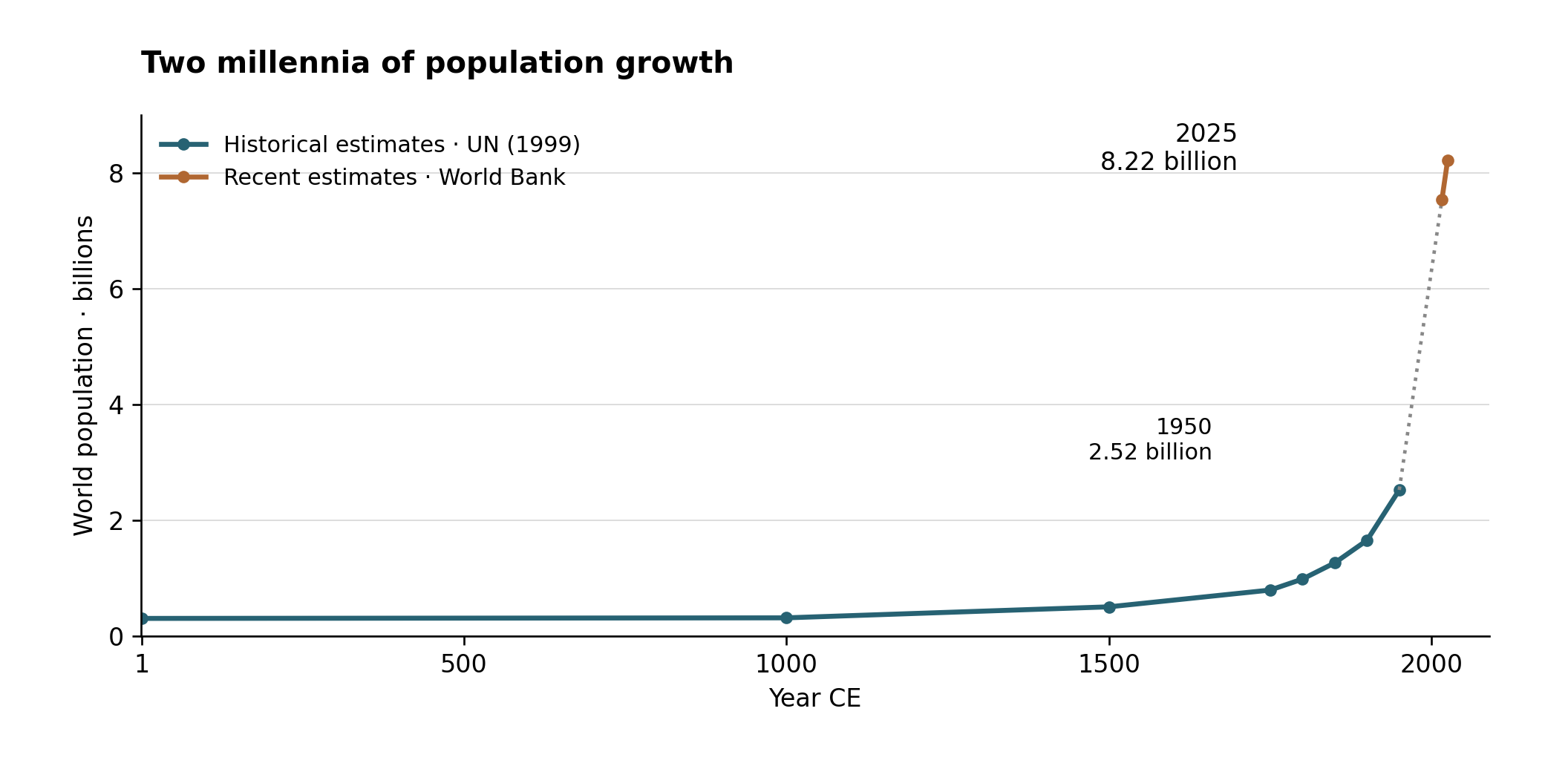
Figure I.2a. The historical rise behind the recent slowdown. Selected estimates, 1–2025 CE, on a linear scale. Historical points use UN (1999), reproduced by the US Census Bureau; 2016 and 2025 use the revised World Bank series in Figure I.2. Lines guide the eye between selected dates; the dotted bridge is not an annual series. Early estimates are uncertain and the two vintages are not used to calculate a continuous growth rate. [I.2, I.19]
The silhouette has the steepening shape that made population such a powerful example in the first book. But the whole history is not one exponential curve with an unchanging rate. The closer view in Figure I.2 reveals a bend hidden by this long perspective: the total still rises while percentage growth slows. Both views matter. One shows the scale of the transformation; the other helps us see where it may be heading.